OEM vs Aftermarket Toyota Parts and in Hazelwood, MO
A practical 2026 guide for Hazelwood Toyota owners on when OEM parts are worth the cost, when aftermarket makes sense, and what to ask before buying.
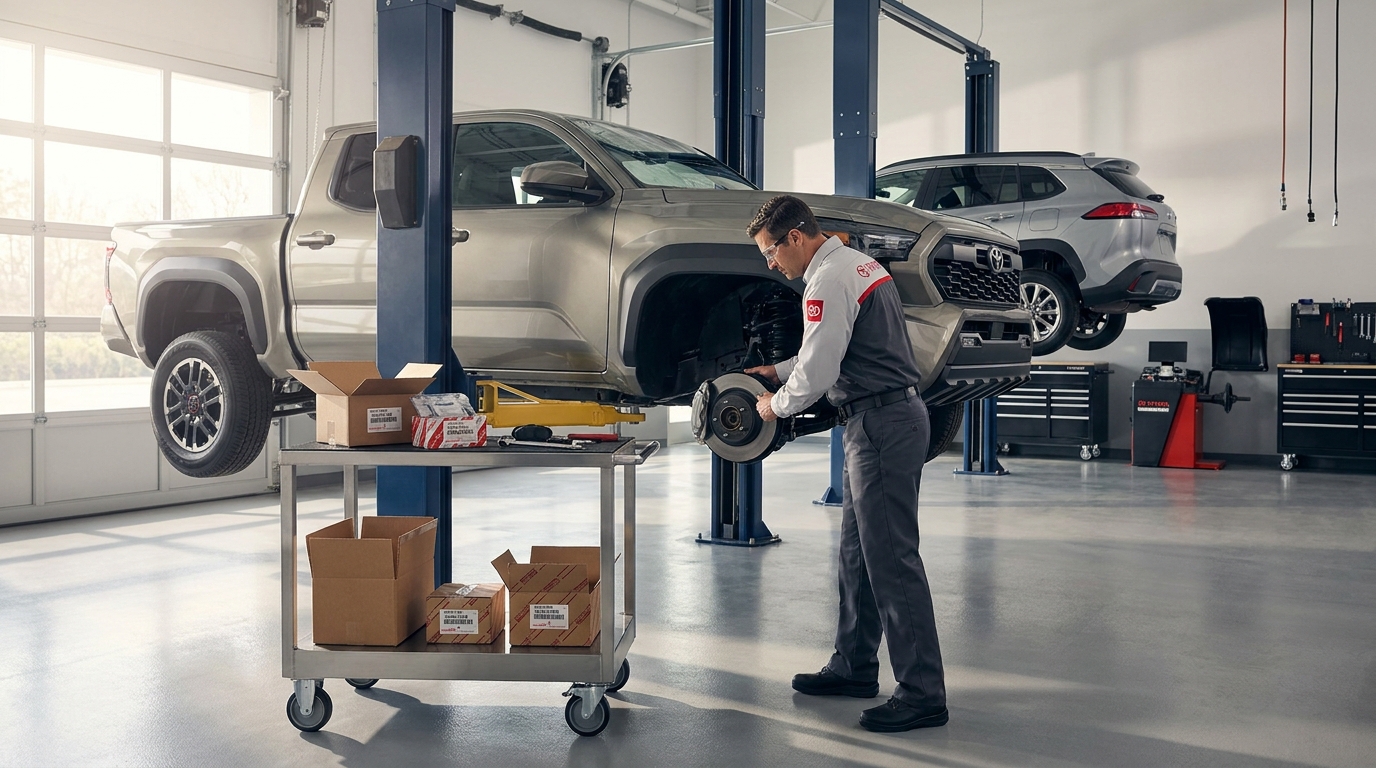
For most Hazelwood Toyota owners, OEM parts are the right call for anything tied to drivetrain, safety, or emissions — think brakes, sensors, cooling, and transmission components — while quality aftermarket parts are reasonable for wear items, cosmetics, and out-of-warranty repairs where fitment tolerances are forgiving. The cost gap is real (often 20-40% on common items), but the warranty, fit, and resale implications usually tip the math toward OEM on anything that keeps the vehicle running or protects a factory warranty.
If you drive a Camry, RAV4, Tacoma, or Highlander through the daily grind on I-270, Lindbergh, or the McDonnell Boulevard corridor, this guide walks through exactly where that math shifts — and what to ask a parts counter before you commit.
What's the real difference between OEM and aftermarket Toyota parts and accessories?
OEM (Original Equipment Manufacturer) Toyota parts are built to Toyota's engineering specs, sold through Toyota's parts network, and backed by Toyota's parts warranty. Aftermarket parts are made by third-party manufacturers to fit Toyota vehicles — quality ranges from excellent (major brand-name suppliers) to poor (unbranded imports), and warranty terms vary by seller.
The critical distinction most Hazelwood owners miss: OEM parts installed at a Toyota dealer like Bommarito Toyota Hazelwood carry a 12-month/12,000-mile parts-and-labor warranty when installed by the dealer, and Toyota Genuine Accessories installed at the time of new-vehicle purchase are covered by the same 3-year/36,000-mile new-vehicle limited warranty as the car itself. Aftermarket parts almost never carry labor coverage, and installing them can complicate — though not automatically void — remaining factory warranty on adjacent systems.
When does OEM actually matter for Hazelwood drivers?
OEM matters most for drivetrain, electronic, safety, and emissions components — anywhere fitment tolerance, sensor calibration, or long-term durability determines whether the vehicle runs correctly. For a Toyota owner in Hazelwood, that specifically means brake components, oxygen sensors, transmission parts, timing components, hybrid battery modules, and anything tied to Toyota Safety Sense.
Missouri winters accelerate this decision. Salt and brine on I-270 and Highway 370 eat brake hardware and undercarriage components faster than in dry climates, and stop-and-go commutes between Hazelwood, Florissant, Bridgeton, and North County put unusual heat cycles through brake pads and rotors. Cheap aftermarket brake pads warp, glaze, or shed material sooner in that environment, and a set that needed replacing every 40,000 miles OEM might last 20,000 in a discount aftermarket version — erasing the savings and adding a labor bill.
When is aftermarket the smart choice?
Aftermarket makes sense for cosmetic parts, high-wear consumables from reputable brands, and repairs on older out-of-warranty Toyotas where you're weighing the cost against the car's remaining value. Air filters, cabin filters, wiper blades, floor mats, bulbs, and body clips from established manufacturers perform comparably to OEM at meaningfully lower cost.
The line to watch: reputable brand-name aftermarket (Denso, Aisin, Bosch, KYB — many of whom actually supply Toyota's OEM parts) versus unbranded parts from generic online sellers. The former is often the same part in different packaging; the latter can be dimensionally wrong, poorly heat-treated, or missing coatings that matter in a road-salt state like Missouri.
How much do you actually save going aftermarket?
Aftermarket savings on Toyota parts typically run 20-40% on common wear items, narrower on complex components, and can flip to a net loss once labor, comebacks, and shortened service life are factored in. The table below reflects typical price ranges for popular Toyota models serviced in the Hazelwood area in 2026.
| Part Category | OEM Price Range | Aftermarket Range | Recommendation |
|---|---|---|---|
| Front brake pads (RAV4/Camry) | $95-$150 | $45-$120 | OEM or premium aftermarket |
| Cabin air filter | $25-$40 | $12-$25 | Quality aftermarket fine |
| Oxygen sensor | $180-$320 | $60-$220 | OEM (or Denso-branded) |
| Headlight assembly | $400-$900 | $150-$500 | OEM if leased/under warranty |
| Wiper blades | $28-$45 pair | $18-$35 pair | Either works |
| Timing chain kit | $450-$700 | $180-$450 | OEM only |
How do Missouri winters and I-270 driving change the calculation?
Hazelwood's climate and traffic patterns wear specific Toyota components faster than the national average, which changes the OEM/aftermarket math on those parts specifically. MoDOT applies salt and brine liberally across I-270, I-170, and Route 367 from roughly November through March, and the freeze-thaw cycles common to the St. Louis metro accelerate corrosion on brake lines, exhaust hangers, wheel bearings, and undercarriage fasteners.
Stop-and-go commutes into the Riverport business area, out to the Boeing campus, or south toward Downtown St. Louis put more thermal cycles through cooling systems and brakes than steady highway miles would. For those components, OEM's tighter tolerances and better corrosion coatings pay back over 3-5 winters. For a garage-kept vehicle driven mostly on surface streets in Old Jamestown or Black Jack, the same premium matters less.
What should you ask the parts counter before ordering?
Before authorizing any Toyota parts order — OEM or aftermarket — ask five specific questions that surface the details most buyers forget. A good parts advisor at Bommarito Toyota Hazelwood or any reputable Toyota parts department should answer all five without hesitation.
- Is this the exact part number for my VIN? Toyota runs mid-year production changes; the correct part depends on VIN, not just year/model/trim.
- What warranty applies — parts only, or parts and labor? Dealer-installed OEM typically includes both; over-the-counter or aftermarket usually does not.
- Does installing this affect any remaining factory warranty? Especially relevant for hybrid, powertrain, or Safety Sense components.
- Is this in stock locally, or does it ship from a regional warehouse? Toyota's Kansas City parts distribution center supplies most Missouri dealers within 24-48 hours.
- For accessories: is this a factory accessory or dealer-installed? This changes the warranty term significantly.
How do Toyota accessories differ from repair parts on warranty?
Toyota Genuine Accessories — roof racks, all-weather liners, tonneau covers, trailer hitches, mudguards — carry different warranty treatment than repair parts, and the timing of installation matters. Accessories installed by a Toyota dealer at the point of new-vehicle sale are covered by Toyota's 3-year/36,000-mile new-vehicle limited warranty. Accessories added later carry a 12-month/12,000-mile accessory warranty from the installation date.
Aftermarket accessories carry only whatever warranty the manufacturer offers, and if an aftermarket trailer hitch causes wiring or frame damage, that damage is on the owner — not on Toyota. For a lease or a vehicle you plan to trade in within five years, this is a meaningful consideration; for a long-hold Tacoma you plan to keep to 200,000 miles, less so.
Frequently asked questions
Does installing aftermarket parts void my Toyota warranty?
No — the federal Magnuson-Moss Warranty Act prevents automakers from voiding a warranty simply because you used aftermarket parts. However, if an aftermarket part directly causes a failure (a bad aftermarket alternator that fries the ECU, for example), Toyota can deny warranty coverage on that specific damage. The safe rule: aftermarket wear items are fine; aftermarket electronics and drivetrain components on a warranty-covered vehicle are risky.
Where does Bommarito Toyota Hazelwood source its parts?
Bommarito Toyota Hazelwood's parts department stocks Toyota Genuine Parts and Toyota Genuine Accessories, supplied through Toyota's regional distribution network. Most common wear items are on-shelf; specialty parts typically arrive within 1-2 business days from the regional parts distribution center. The dealership serves Hazelwood, Florissant, Bridgeton, Berkeley, Ferguson, Black Jack, and the broader North County area.
Are Denso or Aisin parts considered OEM?
Denso and Aisin manufacture many of Toyota's factory parts, so a Denso oxygen sensor or Aisin water pump sold in aftermarket packaging is often physically the same component supplied to Toyota — just without the Toyota part number and box. These are the strongest aftermarket options for Toyota vehicles. Off-brand "fits Toyota" parts from unknown manufacturers are a different category entirely and carry more risk.
Should I buy OEM parts for an older, high-mileage Toyota?
It depends on the part and your plans for the vehicle. For a 2026 Camry with 150,000 miles you plan to drive another two years, quality aftermarket brake pads, filters, and belts are reasonable. For safety-critical components (steering, suspension bushings, wheel bearings) or anything you'd hate to replace twice, OEM is still worth the premium. Missouri road salt punishes cheap suspension components especially hard.
How do OEM accessories affect trade-in value in the Hazelwood market?
Toyota Genuine Accessories generally hold value better at trade-in than aftermarket equivalents because they're documented in the vehicle's service records and match factory fitment. A dealer-installed OEM tow package, roof rack, or bed cover typically shows up as a valuation adjustment; an aftermarket equivalent often doesn't. This matters more in North County where trucks and SUVs dominate trade-in inventory.
Can I order Toyota parts online and have them installed at a dealer?
Most Toyota dealerships, including Bommarito Toyota Hazelwood, will install customer-supplied parts, but the labor warranty typically covers only the workmanship — not the part itself. If the part fails, you're responsible for the second labor charge. Buying the part through the dealer's parts department consolidates warranty coverage under one roof, which is usually the better setup for anything beyond simple bolt-on items.
The bottom line for Hazelwood Toyota owners
Buy OEM for drivetrain, safety, emissions, and anything with a sensor or a warranty implication. Buy quality-brand aftermarket for filters, wipers, bulbs, and cosmetic wear items on older vehicles. Avoid unbranded aftermarket parts entirely — the savings rarely survive a Missouri winter.
Readers in Hazelwood, MO who want a specific part looked up by VIN, an accessory installed under factory warranty, or a straight answer on whether OEM is worth it for a specific repair can reach the parts team at Bommarito Toyota Hazelwood through bommaritotoyota.net. The dealership's 4.7-star rating across more than 4,100 Google reviews reflects the no-pressure approach one recent customer described simply: "No pressure and he was professional." That same posture applies at the parts counter.