Keep Car or Buy New? Cost Analysis for Berkeley, MO
A break-even cost comparison for Missouri drivers weighing repairs, depreciation, and insurance shifts before buying new in 2026.
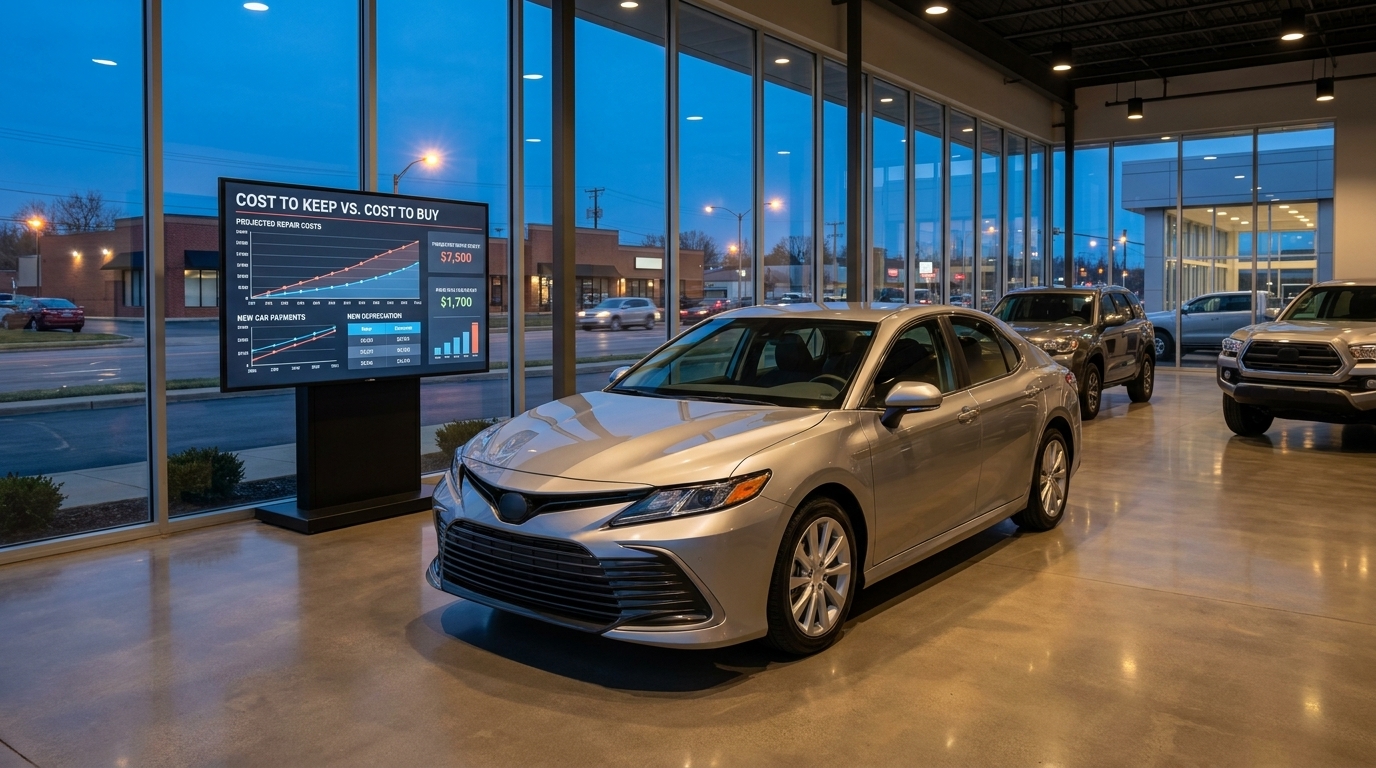
For most Berkeley, MO drivers in 2026, keeping your paid-off car makes financial sense until your annual repair bills exceed roughly 50% of a comparable new-car payment for two consecutive years, or a single repair tops the vehicle's trade-in value. Buying new wins when repair frequency climbs, safety tech gaps grow, or fuel and insurance math finally tips the other way. The honest answer depends on your specific repair trajectory, not a rule of thumb.
Below is a real cost framework — repair costs, depreciation, insurance, and Missouri-specific tax treatment — so you can run the math for your own driveway before you shop.
Is it worth buying a new car in 2026, or should you keep what you have?
Keep your current car if it runs reliably, annual repairs stay under about $2,000, and it still fits your life. Buy new when repair bills become unpredictable, the car no longer suits your commute or family, or a major failure (transmission, engine, hybrid battery) would cost more than the car is worth. In 2026, average new-vehicle transaction prices remain near $48,000 according to Kelley Blue Book, so the bar for switching should be genuinely high.
The break-even test we recommend at Bommarito Toyota Hazelwood is simple: add 12 months of expected repairs, insurance, and fuel for your current car, then compare it to 12 months of payment, insurance, and fuel on the new car you'd actually buy. If the gap is less than $150 per month and your current car has known problems ahead, new starts to make sense.
How do repair costs compare to a new car payment in Berkeley, MO?
A typical new-car loan in the Berkeley, MO market runs $550-$750 per month over 72 months at current 2026 rates. That's $6,600-$9,000 per year in payments alone. If your current car costs $1,800 a year in repairs, keeping it saves roughly $5,000 annually — even after factoring a couple of surprise repairs.
The tipping point comes when repairs become a pattern rather than an event. Watch for these signals:
- Two or more repairs over $1,000 in a single year
- A single repair estimate that exceeds the car's private-party value
- Repeat failures of the same system (transmission, cooling, electrical)
- Rust perforation on frame or subframe components — common on older vehicles that lived through Missouri winters and I-70 road salt
Older vehicles in north St. Louis County take a real beating from freeze-thaw cycles between November and March. If you're seeing brake line or fuel line corrosion, that's often the first honest signal the car is nearing end-of-life for daily driving.
How does depreciation change the math for a new car?
New vehicles typically lose 20-30% of their value in the first year and roughly 60% by year five, per Edmunds and industry depreciation data. That means a $40,000 new car may be worth $28,000-$32,000 after 12 months. Your paid-off older car, by contrast, has already absorbed its steepest depreciation — every additional year of ownership is effectively free on that dimension.
This is why the financial case for keeping a reliable, paid-off vehicle is so strong. You are, in effect, driving at cost — insurance, fuel, and maintenance only. The counterpoint: Toyota and other reliability-leading brands hold value better than the segment average, which softens the depreciation hit if you do buy new and plan to keep the vehicle 8-10 years. Certified pre-owned is a middle path worth considering if you want newer without the first-year depreciation cliff.
How do Missouri insurance and taxes shift the comparison?
Missouri drivers face two location-specific costs that reshape the keep-or-buy math. First, insurance: comprehensive and collision premiums are materially higher on newer, more expensive vehicles, and Missouri's average auto insurance premium has continued rising through 2026. Expect a jump of $40-$90 per month when moving from an older car with liability-only coverage to a new financed vehicle requiring full coverage.
Second, Missouri sales tax on vehicle purchases is 4.225% at the state level, plus local rates that push the combined rate in St. Louis County to roughly 7.7-8.5% depending on the specific taxing district. Missouri does offer a trade-in tax credit — you pay sales tax only on the difference between the new vehicle's price and your trade-in value, which can save thousands. Missouri also allows a 180-day window to apply a sale of another vehicle toward that tax credit if you sell privately instead of trading in. Confirm current rules with the Missouri Department of Revenue before you finalize numbers.
Side-by-side: keeping your car vs. buying new in 2026
Here's a realistic annual cost comparison for a Berkeley, MO driver choosing between keeping an 8-year-old paid-off sedan and financing a new one:
| Cost Category | Keep Current Car (8-year-old, paid off) | Buy New (financed, 72 months) |
|---|---|---|
| Monthly payment | $0 | $550-$750 |
| Annual repairs/maintenance | $1,200-$2,400 | $200-$500 (warranty period) |
| Annual insurance | $900-$1,400 (liability-focused) | $1,600-$2,400 (full coverage) |
| Annual fuel (12k miles) | $1,900-$2,400 | $1,400-$2,000 (better MPG or hybrid) |
| Annual depreciation | $400-$800 | $4,500-$7,000 (year one) |
| Total year-one cost | $4,400-$7,000 | $14,300-$20,900 |
The gap narrows in years 4-6 as repairs on the older car climb and depreciation on the new car flattens. That's where certified pre-owned and hybrid options often make the most sense — and where a no-pressure conversation with a dealer helps you see the trajectory, not just the snapshot.
When does buying new actually pay off?
Buying new pays off when three conditions overlap: your current car's repair pattern is escalating, your commute or family needs have changed, and fuel savings from a hybrid or more efficient vehicle offset a meaningful share of the new payment. For a 40-mile round-trip commute from Berkeley into the St. Louis metro, switching from a 22-MPG SUV to a 45-MPG hybrid saves roughly $1,400-$1,800 a year in fuel alone.
Safety technology is the other legitimate reason to buy new. Automatic emergency braking, blind-spot monitoring, and lane-keep assist are standard on nearly all 2026 Toyota models and demonstrably reduce collision rates per IIHS data. If you're driving I-170 or I-270 daily, that matters. Bommarito Toyota Hazelwood carries the full 2026 lineup along with certified pre-owned inventory for buyers who want newer safety tech without the full new-car cost.
Frequently asked questions
At what repair cost should I stop fixing my old car?
A common benchmark: stop investing when a single repair exceeds the car's private-party value, or when annual repair costs top 50% of what a comparable used replacement would cost. For a car worth $6,000, a $3,500 transmission repair is a clear signal to move on. Also weigh reliability — two unpredictable failures in a year erode the car's real utility even if individual repairs are affordable.
Does Missouri give a tax break for trading in my old car?
Yes. Missouri applies sales tax only to the difference between the new vehicle's purchase price and your trade-in credit, not the full sticker price. On a $35,000 new car with a $10,000 trade, you're taxed on $25,000 — saving roughly $800-$1,000 depending on your local rate. Missouri also allows you to apply the private sale of another vehicle within 180 days toward the same credit. Verify current rules with the Missouri Department of Revenue.
Is a certified pre-owned Toyota a smarter middle ground?
Often, yes. Certified pre-owned Toyotas typically come with a multi-point inspection, extended powertrain coverage, and a lower price than new — while avoiding the steepest first-year depreciation. For budget-conscious Berkeley, MO buyers who want newer safety tech and reliability without a new-car payment, CPO frequently produces the lowest 5-year total cost of ownership.
How much does full-coverage insurance rise when I finance a new car?
Financed vehicles require full coverage (comprehensive and collision), which typically adds $40-$90 per month over a liability-focused policy on an older paid-off car. The exact increase depends on your driving record, ZIP code within Berkeley, MO, credit tier where legally used, and vehicle model. Get a quote on your specific new vehicle before finalizing the purchase — surprises here can shift the break-even math meaningfully.
Should I worry about rust on my older car in the Berkeley, MO climate?
Yes, especially on vehicles 10+ years old. Missouri winters use significant road salt, and repeated freeze-thaw cycles accelerate corrosion on brake lines, fuel lines, and subframe components. Have a shop put the car on a lift once a year and look specifically at structural rust. Perforated frame rails or rotted brake lines can turn an otherwise-drivable car into a safety liability and a poor repair investment.
What's the fastest way to know if trading in makes sense for me?
Get a current trade-in value on your car, then price the new or certified vehicle you'd actually buy. Compare 12 months of expected costs on each — payment, insurance, fuel, and realistic repairs. If the new-car total is within $150 per month of keeping your current car and you have known repairs coming, buying starts to make sense. A quick appraisal at a dealer like Bommarito Toyota Hazelwood gives you the trade number to run the math accurately.
The bottom line for Berkeley, MO drivers
Keep your car when it's reliable, paid off, and still fits your life — that's usually the winning financial move. Consider buying when repairs escalate, safety tech gaps matter, or a fuel-efficient replacement genuinely closes the monthly gap. Certified pre-owned often threads the needle for buyers who want newer without the full new-car cost.
Readers in Berkeley, MO who want help running the actual numbers on their vehicle can reach Bommarito Toyota Hazelwood at https://www.bommaritotoyota.net/ for a trade appraisal and side-by-side comparison. Bommarito Toyota Hazelwood's 4.7-star rating across more than 4,100 Google reviews reflects a consistent theme in customer feedback — one recent reviewer described the experience simply as "no pressure and he was professional" — which is the right posture for a decision this financially significant.